gps-trackers
Best Wireless Dog Fence Without Subscription? Here's the Honest Breakdown
No-subscription wireless dog fences exist, but GPS and radio-signal containment trade reliability for that freedom. Here's what actually works and for whom.
Published 2026-08-05 · 9 min read
Disclosures
Affiliate links + health guidance. Informational only — consult your veterinarian and check manufacturer specs before relying on any pet-health feature.
TL;DR
- No-subscription wireless fences are real, but they trade convenience for reliability. GPS systems drift in wooded yards; radio systems max out at ½ acre; both fail if you skip training.
- Best no-subscription GPS option: PetSafe Guardian GPS (~$450, 3/4+ acres, no trees) — Amazon ASIN B0D83MQBZ3 for larger suburban yards.
- Best no-subscription radio-signal option: PetSafe PIF-300 (~$290, ½ acre, proven 25+ years) — Amazon ASIN B0001ZWZ8O for small yards and tech-minimalists.
- Important honesty: Wireless fences are less reliable than buried in-ground wire, especially in woods, on hills, or with escape-artist dogs. Shock collars are banned in Wales, Scotland (pending), most of EU, and Australia (4 states). For anxious dogs, AVSAB opposes any aversive correction. Check local law and your dog's temperament before buying.
- Not a containment tracker? If your dog bolts and you need to find him, that's a different product. See our guide on GPS dog trackers without a monthly fee — trackers tell you where he went; fences try to stop him from leaving in the first place.
As an Amazon Associate I earn from qualifying purchases made through links in this review. It doesn't change the price you pay. This guide is based on manufacturer specifications and published independent reviews, not personal hands-on testing of every device. Wireless fence systems use aversive correction (static pulse); the American Veterinary Society of Animal Behavior opposes aversive correction. Consult a certified veterinary behaviorist before using any shock-collar system on anxious dogs. Shock collars are banned in Wales, Scotland (pending), most of the EU, and four Australian states — check local law.
Does "no monthly fee" mean better?
No. Wireless fences have no fees, but they aren't simpler or more reliable than buried wire. They just cost less upfront. Wireless fences come in two types: GPS systems (PetSafe Guardian) use satellites to set boundaries, and radio systems (PetSafe PIF-300) use a home transmitter with a fixed range. Both skip monthly fees. But you trade reliability for that, especially in woods or hills where GPS drifts.
This guide shows which no-fee system works for your yard and dog. It also covers where they fail, safety issues, and who should skip them. Choose the option that fits your situation.
What are the no-fee options?
| System | Technology | Price | Range | Best For |
|---|---|---|---|---|
| PetSafe Guardian GPS | GPS (satellite) | ~$450 | 3/4+ acres | Large yards with open space |
| PetSafe PIF-300 | Radio signal | ~$290 | ½ acre (90 ft) | Small yards, no app wanted |
| SpotOn Fence | GPS (satellite) | ~$999 | 999 yards | Large properties, premium quality |
All three have no ongoing fees. One payment covers the device forever. But they differ in how they work, how far they reach, and how well they work in different yards. Pick the wrong one and you waste your money.
Is PetSafe Guardian GPS worth ~$450?
Price: ~$450 | ASIN: B0D83MQBZ3
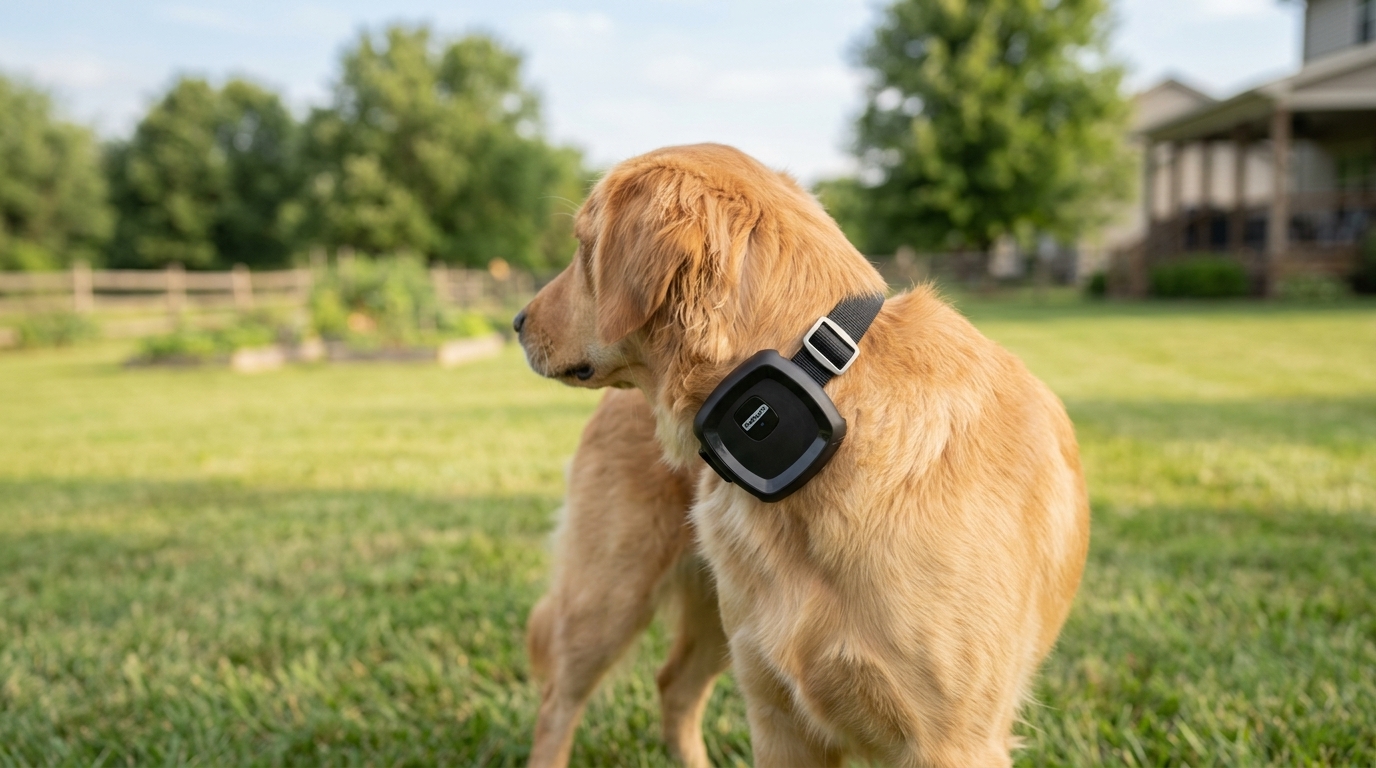
Guardian is PetSafe's flagship GPS fence. You draw a boundary on your phone. The collar vibrates or corrects when your dog crosses. Specs: 3/4+ acre coverage, 5-day battery (2–3 days actual use), motion detection, 10 correction levels, tone and vibration options, dogs over 25 lbs, neck 13–28 inches, setup 1–2 hours, supports 5 dogs per account.
Strengths: The motion sensor stops false corrections when GPS signal drifts slightly. PetSafe's 25-year track record means spare collars and batteries are widely available. Owners report that motion detection cuts training time by reducing frustration.
Drawbacks: GPS drifts 5–15+ feet in trees. Wooded yards (50%+ trees) have high escape risk from drift gaps. App-based setup requires a phone. GPS lag (1–2 seconds) means corrections fire after your dog has already crossed a busy road.
Buy if: You have an open suburban yard of 3/4+ acres, dogs over 25 lbs, a smartphone, and can charge weekly.
Skip if: Wooded property, dogs under 25 lbs, no phone, near busy roads.
Is PetSafe PIF-300 right for small yards?
Price: ~$290 · ASIN: B0001ZWZ8O
PIF-300 uses radio signals. A transmitter you plug into your garage broadcasts a fixed circular boundary up to 90 feet (½ acre max). Dogs 8 lbs and up, neck 6–28 inches. Replaceable 6V battery lasts 3–6 months, about $20–30 per battery. No app, no internet, no cloud.
Strengths: Proven over 25+ years across millions of installations worldwide. Stable radio signal, zero drift, no GPS lag whatsoever. Setup takes just 20 minutes. Simple enough that grandparents can operate it without help. One transmitter supports unlimited dogs.
Limits: ½ acre is the hard ceiling. System is useless if your yard is larger. Radio signal can be blocked by thick vegetation or large metal structures. No app logs or customization options. You adjust correction levels with a simple dial on the transmitter.
Buy if: You have a small yard (under ½ acre), want simple setup, prefer no app, have multiple dogs, or like one transmitter for all.
Skip if: Your yard is over ½ acre, you want app control or custom boundaries, metal is nearby, or you need to move the system.
Note on SpotOn Fence: (~$999, premium GPS option). Better build quality than Guardian but 2× the price. Still drifts in trees, and live tracking requires a separate SIM plan. Only if price is no object.
Why do wireless fences fail?
Wireless fences fail in several predictable ways:
GPS drift in trees. Five to 15+ foot drift is common under tree canopy. Your dog gets corrected for standing in its own yard, or finds gaps and escapes. Forest Mode and other tree corrections still drift in real-world wooded properties.
High-drive dogs. Huskies, sighthounds, and rescues with escape history charge through before the collar can react. GPS lag runs 1–2 seconds. By then your dog is already 10–20 feet out. Radio systems also can't react fast enough to stop a dog with momentum.
Skipped training. Dogs need 2–4 weeks of daily flag training and praise. Without it, they fear the boundary instead of respecting it. They get anxious around the perimeter. Owners skip training to save time. This always costs them later.
Near busy roads. Wireless reacts too slow to stop a car accident. By the time the collar corrects, your dog is already in the street. For homes on busy roads, use physical fencing or hire a trainer instead.
Is a shock collar legal and humane where you live?
What veterinarians say: AVSAB and AAHA say don't use shock collars. Shock training increases fear and aggression. Reward-based training works better and is more humane.
Anxious dogs: Shock training may make anxiety worse. Talk to an animal behavior expert instead.
Banned in: Wales (2010), Scotland (pending), EU nations (Germany, Austria, Switzerland, France, Spain, Denmark, Sweden, Norway, Iceland), Belgium/Flanders (2027), Australia states (ACT, Queensland, South Australia, NSW).
United States: Legal federally in all 50 states, though some cities/counties restrict.
Check your local law. Many pet owners don't know collars may be illegal where they live.
Should you skip wireless entirely?
Yes, if any of these apply:
- Toy breeds (under 8 lbs): Collar weight is unsafe.
- Heavily wooded or hilly: GPS drift is too high. Buried wire is more reliable.
- Escape-artist dogs: Bolters and sighthounds are too risky. Use buried wire or hire a trainer.
- Anxious dogs: AVSAB opposes aversive correction. Consult a veterinary behaviorist.
- High-traffic properties: Wireless reacts too slow to prevent collisions.
- Renters: Many leases prohibit them. Confirm landlord approval first.
- Won't commit to 2–4 weeks training: Dogs learn fear, not respect. Hire a trainer instead.
- Banned jurisdictions: Wales, Scotland (pending), EU, Australia. It's illegal where you are.
So which one should you buy?
Open suburban yard (3/4+ acres, few trees): PetSafe Guardian GPS (~$450). Accept GPS drift and commit to training.
Small yard (≤½ acre, simplicity preferred): PetSafe PIF-300 (~$290). Proven, straightforward, reliable.
Wooded, hilly, high-traffic, or escape-risk yard: Skip wireless. Buried in-ground wire is more reliable. Or check out smart dog doors for supervised containment.
Anxious dog or banned jurisdiction: Skip wireless entirely. Consult a veterinary behaviorist. Consider activity trackers for monitoring instead.
Bottom line: No-fee wireless fences work only in specific scenarios. Open yards, trained dogs, and clear terrain are required. They're not better than buried wire — just cheaper upfront if your exact conditions match. Buy only if your specific yard and dog fit the use case.