Best Automatic Ball Launchers for Dogs 2026: Safety, Throw Distance, and Which Dogs Should Skip It
Research-backed picks for automatic ball launchers, including safety screening and honest failure modes. Who should NOT buy one.
Published Aug 10, 2026 · 10 min read
As an Amazon Associate, I earn from qualifying purchases. Your price stays the same.
TL;DR
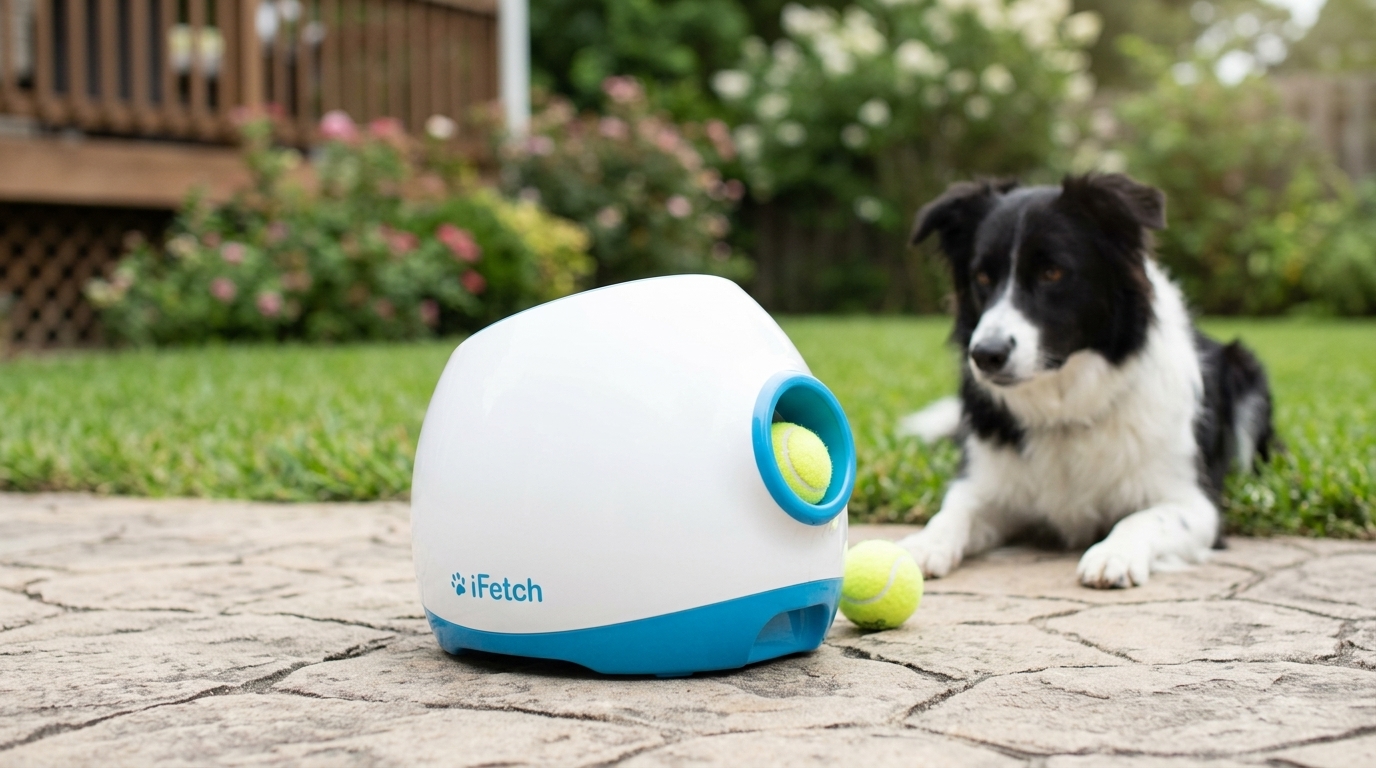
- Best overall, small-to-medium dogs: iFetch Ball Launcher (~$50). Compact, wall-plug powered (no battery drain), 10-30 foot adjustable throws. Best for apartments and dogs under 50 lbs.
- Best for large, active dogs: iFetch Too (~$100-120). Rechargeable, 40-foot range, time-tested reliability. Best for spacious yards and medium-to-large breeds.
- Best if you want enforced rest: PetSafe Automatic Ball Launcher (~$50-70). Motion sensor, 9 distance settings, automatic 30-minute play limit. Best for owners who need the device to stop their dog from overexercising.
- Most affordable: MEKAPLE Automatic Ball Launcher (~$60-80). Remote control, throws up to 79 feet, budget-friendly. Best for large dogs in big yards, lower price tolerance.
- ⚠️ Do NOT buy if: your dog is under 12-18 months old, has existing joint issues, is obsessed with balls, won't release the ball, is a senior (10+) without vet clearance, or is a toy breed under 10 lbs without a mini-ball model.
As an Amazon Associate I earn from qualifying purchases made through links in this review. It doesn't change the price you pay. These picks are based on manufacturer specifications, veterinary guidance, the Center for Pet Safety, published independent reviews, and verified-buyer feedback, not personal hands-on testing of each device.
An automatic ball launcher promises an end to tennis elbow and a way to tire out a high-energy dog. But the moment it's needed most, when your dog is frantic with energy or you're in a rush, is also when the device's real limitations surface. Below is what the sources reveal about which launchers actually deliver on their claims, which ones jam or lose distance when your dog slobbers on the ball, and the honest safety screening every owner should do before pressing buy.
How we evaluated: manufacturer specs from iFetch, PetSafe, and MEKAPLE; veterinary guidance from the AVMA and the Center for Pet Safety; published reviews from Whole Dog Journal, Dogster, and VetExplainsPets; and verified-buyer feedback aggregated from 2,000+ reviews across multiple platforms.
Who should NOT buy an automatic ball launcher
Before we talk about which model to pick, here's who should sit this out entirely. An automatic launcher is high-impact exercise, and for certain dogs, it's a serious health or behavioral risk.
Puppies under 12-18 months (especially large breeds). Growth plates don't fully ossify until 12-18 months in most dogs, and 24+ months in giant breeds. Repetitive high-impact fetch can cause cartilage damage, stress fractures, and early-onset arthritis. The AVMA cautions against overdoing high-arousal activities during growth. If your dog is still growing, wait, or consult your vet about a gentler alternative.
Dogs with pre-existing orthopedic issues. Hip dysplasia, elbow dysplasia, arthritis, ACL tears, or spine issues. Even low-speed modes can exacerbate joint damage. VetExplainsPets notes that repetitive, high-impact exercise causes cumulative stress-fracture risk in dogs with existing joint vulnerability. Talk to your vet before introducing one.
Compulsive or ball-obsessed dogs. Some retrievers and spaniels develop pathological fixation on balls, a real behavioral condition. An automatic launcher that makes fetch endlessly available can worsen compulsive behavior and anxiety when the device is off. Veterinary behaviorists warn that automatic launchers can reinforce obsessive patterns rather than provide healthy enrichment.
Dogs that won't release the ball. If your dog guards balls, refuses to drop them, or won't bring them back, an automatic launcher is a $50-120 shelf item. It physically cannot work without the dog returning the ball. Test your dog's willingness to release and retrieve before you buy.
Senior dogs (10+ years) without veterinary clearance. Age-related joint decline means even moderate fetch can be painful. Arthritis, bone density loss, and cardiovascular decline are common in seniors. Always consult your vet before introducing a launcher with an older dog.
Small toy breeds under ~10 lbs without mini-ball models. Standard 2.5-inch tennis balls pose a choking hazard and don't fit toy-breed mouths. The Center for Pet Safety documents fatalities from balls lodging in small dogs' throats. Only the iFetch mini-ball launcher (2-inch balls) is safe for toy breeds; other models use standard balls.
If your dog doesn't fit any of these categories, read on. If they do, a launcher isn't the right fit, and your vet will back you up.
Which launcher is right for which dog? (Comparison matrix)
| Model | Throw Distance | Ball Size | Power Source | Runtime | Price Tier | Best For | Motion Sensor |
|---|---|---|---|---|---|---|---|
| iFetch (small/medium) | 10, 20, 30 ft (3 presets) | Mini (2") | Wall plug or 6 C-batteries | Continuous (plug) or ~90 min | ~$50 | Small dogs, apartments, no battery worry | No |
| iFetch Too (medium/large) | 10, 25, 40 ft (3 presets + random) | Standard 2.5" | Rechargeable lithium | ~300 launches per charge | ~$100-120 | Medium-large dogs, backyards 40+ ft, durability | No |
| PetSafe (PTY00-14665) | 8–30 ft (9 settings + 6 angles) | Standard 2.5" | 6 D-cells or power cord | ~400 launches per battery set | ~$50-70 | Dogs 10+ lbs, enforced rest-mode protection, angle control | Yes (7-foot range) |
| MEKAPLE (large/medium variant) | 29, 39, 79 ft + random mode | Standard 2.5" | 6 AA batteries | ~300 launches per set | ~$60-80 | Large-dog owners, long-range fetch, budget-conscious | No |
| MEKAPLE (small/medium variant) | 19, 32, 45 ft | 2.2" ETPU | 3 AA batteries | ~200 launches per set | ~$40-50 | Budget buyers, small dogs, testing the category | No |
Key takeaway: iFetch dominates durability and ease-of-use (wall-plug model never depletes batteries); PetSafe offers the most safety (motion sensor + enforced rest); MEKAPLE delivers long distance and remote control at the lowest price.
Best iFetch launcher for small-to-medium dogs: which model?
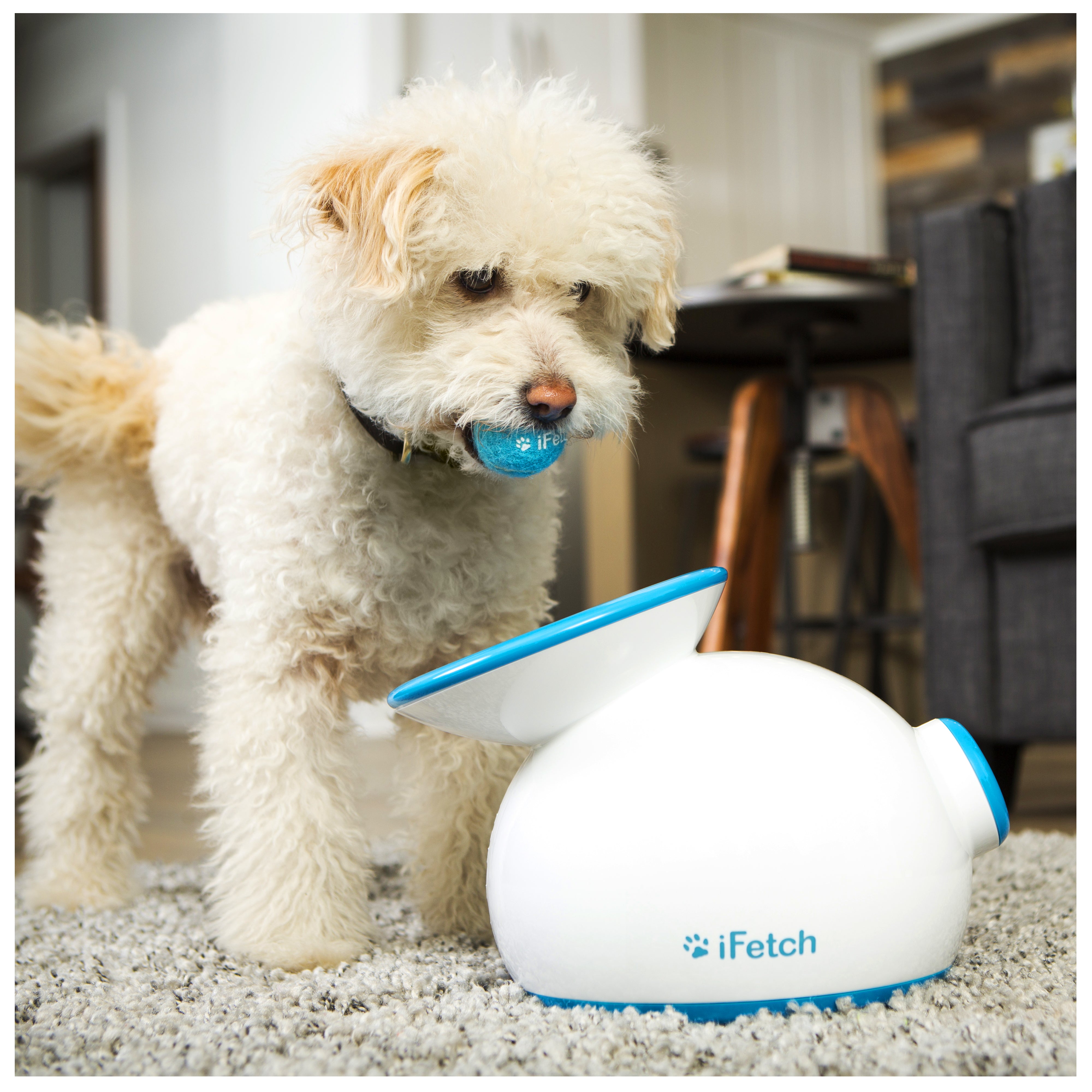
The iFetch Ball Launcher is the most convenient launcher to own, because it plugs into a wall outlet. No battery ever dies mid-session. You set it for 10, 20, or 30 feet, and it throws for as long as your dog will fetch, or until you unplug it.
The compact design and mini-ball compatibility (2-inch balls) make it the only safe choice for toy breeds under 10 lbs. For small-to-medium dogs (under 50 lbs), iFetch's modest throw distance (30 feet max) is actually a feature: it's ideal for apartments and smaller yards, and it matches the veterinary guidance to limit fetch sessions to 5-10 minutes anyway.
The catch: no battery option means you're tethered to an outlet. For backyard use that's fine; for a trip to the dog park, it's not portable.
Across 400+ Amazon reviews, owners praise the simplicity and reliability. Common complaints: the device is loud, it doesn't have a distance-random mode (you pick one distance per session), and it's best for dogs under 50 lbs.
Which launcher works best for large, active dogs?
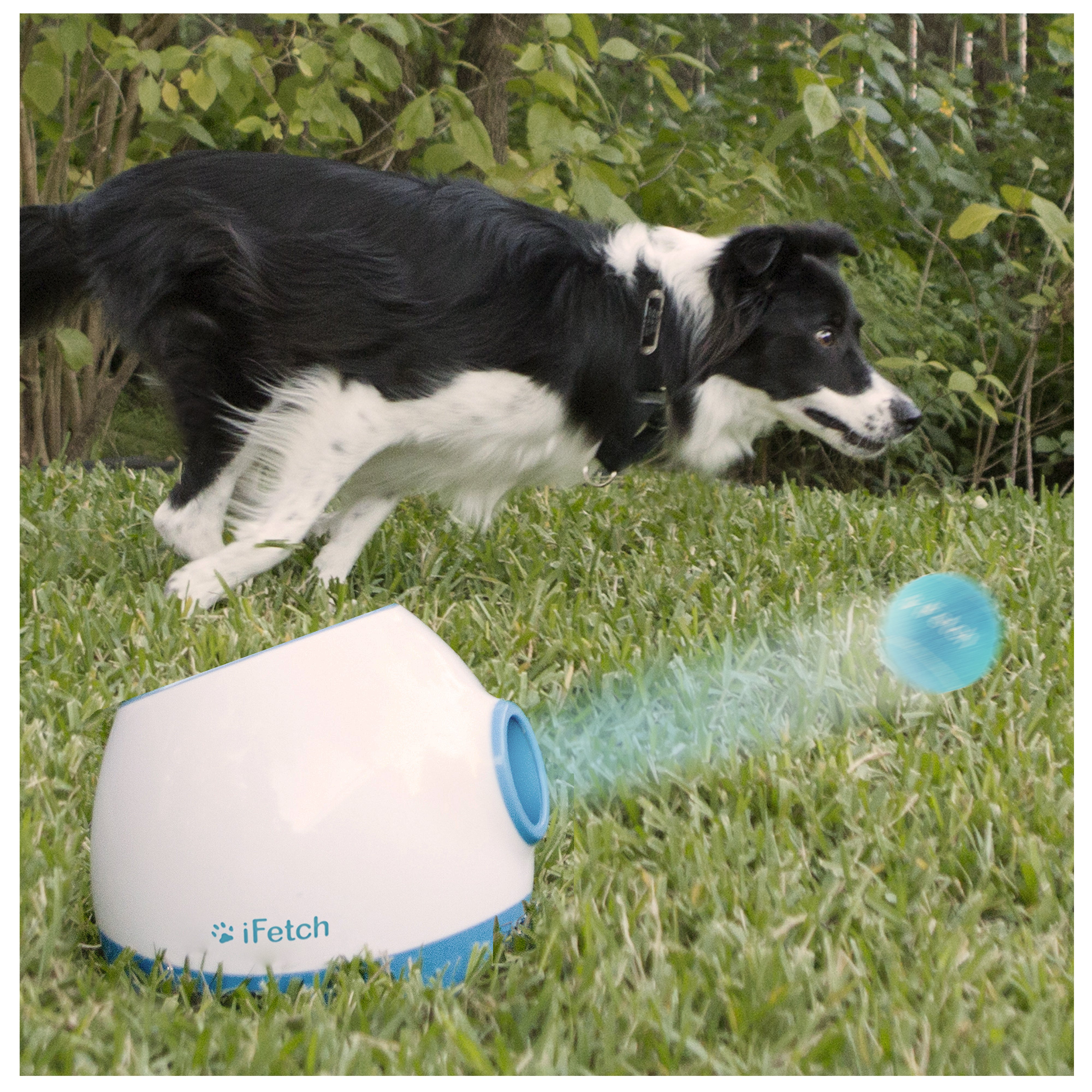
The iFetch Too is iFetch's premium model for medium-to-large dogs. It uses a standard 2.5-inch tennis ball, has a 40-foot throw distance, and ships with a rechargeable battery that lasts ~300 launches per charge. It also adds a random distance mode alongside the three presets (10, 25, 40 feet), so dogs can't predict the throw.
The rechargeable battery is a game-changer for owners who can't run a cord across the yard. Owners report solid durability, the iFetch brand has the highest trust score across review platforms, likely because it's been in the market longest and uses simple mechanics (fewer jam-prone parts than newer competitors).
The trade-off: At ~$100-120, it's pricier. The 40-foot range is excellent for big yards; for a small yard or apartment, it's overkill.
Common praise: reliable rechargeable battery, 40-foot throw is genuinely impressive, and the build feels durable. Common complaints: still loud, the random mode isn't truly random (it rotates through presets in order), and a few owners report inconsistent distance.
Does PetSafe's enforced rest feature actually prevent overexercise?
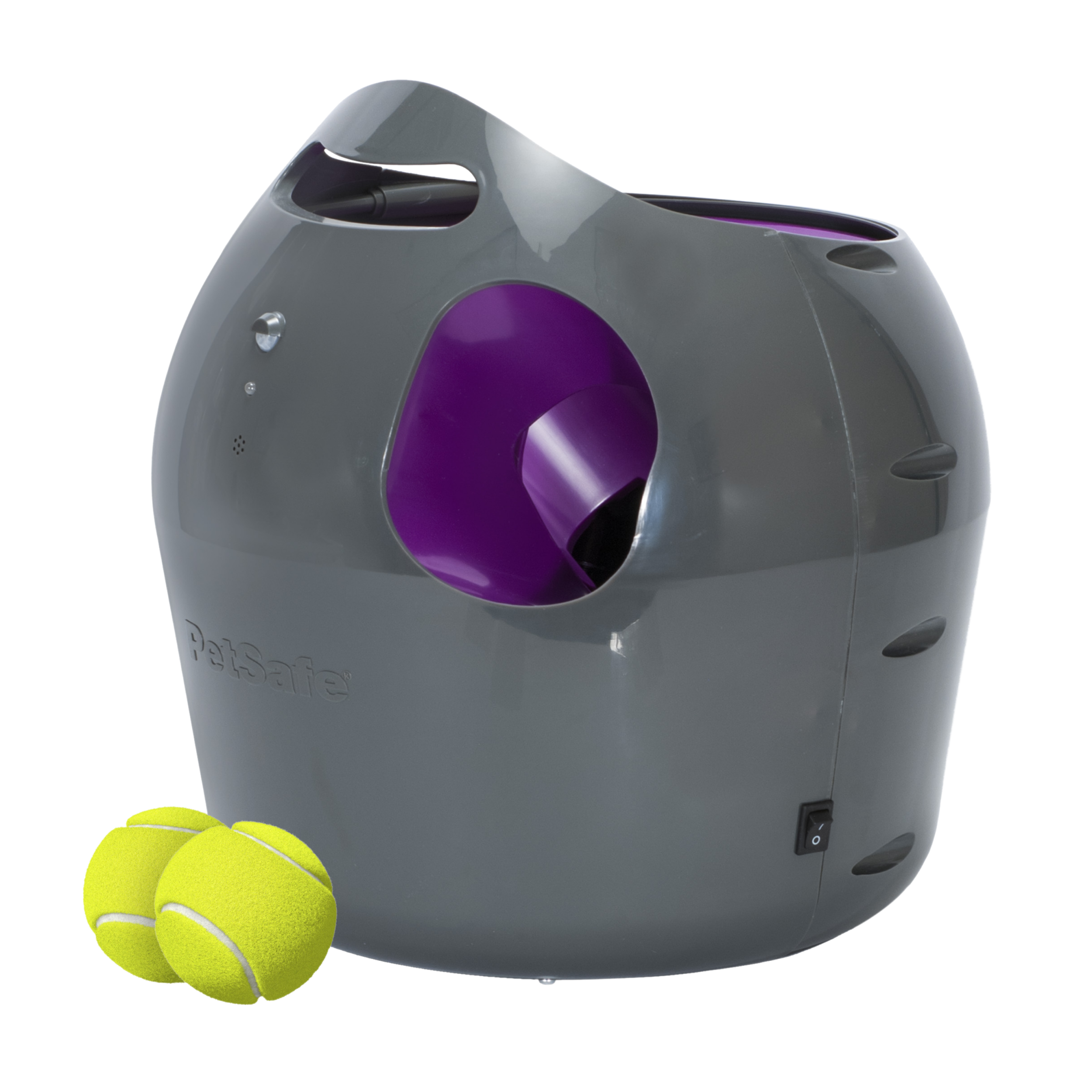
The PetSafe Automatic Ball Launcher (model PTY00-14665) is unique because it enforces a 30-minute play limit followed by a 15-minute rest period. This is a controversial feature: some owners love it because it prevents their dog from overexercising; others hate it because it locks them out when their dog wants to keep playing.
The device includes a motion sensor that detects dogs within 7 feet and prevents a launch if the dog is too close, a genuine safety feature that reduces accidental close-range throws. It also offers the most angle flexibility of any launcher: 9 distance settings (8–30 feet) and 6 angle presets, so you can adjust throw height and direction.
The power-source trade-off: runs on 6 D-cell batteries or mains power (cord included), so you get flexibility without relying on a rechargeable battery that ages.
The catch: the enforced rest mode. If your dog won't stop wanting to fetch, you can't just keep playing, the device locks you out for 15 minutes. For owners of high-energy dogs (especially Labradors and Border Collies), this is frustrating. For owners who worry their dog will overfetch, it's a blessing.
Common praise: the motion sensor works reliably, the angle control is useful, and the enforced rest is a real safety feature. Common complaints: the 30-minute play limit is too strict, the motion sensor can be circumvented if a dog drops the ball into the chute without backing away, and the device is bulkier than iFetch.
What's the best budget launcher with remote control?
The MEKAPLE is the affordability and remote-control champion. It is rated for three set distances: 29, 39 and 79 feet, plus a random mode the listing puts at 20-70 feet, includes a remote control so you can trigger throws without walking to the device.
MEKAPLE makes two size variants (one for medium/large dogs at ~$60-80, one for small/medium at ~$40-50). Both are Amazon-only brands with no official manufacturer site, but they have strong customer ratings and aggressive pricing.
The remote control is genuinely useful, especially if you have mobility issues or want to control throws from across the yard. The random mode is fully random (not preset rotation), so dogs can't predict throws.
The catch: power source is 6 AA batteries (or 3 AA for the small variant), which deplete with use. No rechargeable option, no wall-plug option. When the batteries die, you're stuck until you recharge or replace them. No motion sensor, so close-range throws are a risk if a dog learns the vulnerability.
Across Amazon reviews, owners praise the remote control, the distance range, and the price. Common complaints: batteries deplete faster than expected on high-speed mode, some owners report distance overclaiming, and the build feels less durable than iFetch after heavy use.
What's the biggest real-world failure mode?
Here's a scenario that plays out across owner forums: A Labrador owner buys a MEKAPLE launcher specifically for its 79-foot top setting. Day 1, the dog is thrilled and the throws look long. By Day 3, the dog has learned to drop the ball into the chute without backing the full 7 feet away (the motion sensor, if present, only detects from 7 feet out). The device fires at close range, and the dog yelps, no injury, but a scary moment. By Week 2, the dog is ball-obsessed and won't play with toys that aren't balls. Meanwhile, the owner keeps the launcher on the porch, frustrated.
What actually happens:
-
Slobber shortens throw distance. A saliva-soaked ball is heavier and grips the launch wheels differently, and owner reviews repeatedly describe throws falling well short of the rated distance once a dog has been fetching for a while. We have not measured the drop ourselves and won't invent a figure. The practical fix is rotating in a dry ball; owners who don't realize this often conclude the launcher is broken.
-
Jamming on muddy balls. If a ball is caked with mud or multiple balls are accidentally loaded, the loader jams. The device won't fire until manually cleared.
-
Motion-sensor gap. Some dogs learn to put their nose or paw in the launch chute without stepping back 7 feet. The motion sensor doesn't catch this geometry, and the device fires at close range. This is documented in PetSafe reviews and is a real safety risk.
-
Ball obsession escalation. A high-obsession breed (Labrador, spaniel) using an automatic launcher multiple times daily can develop compulsive fixation on balls. When the launcher is off, the dog's anxiety spikes, pacing, whining, destructive behavior.
These aren't defects in the launchers, they're use-pattern realities that marketing doesn't highlight. Knowing them ahead of time lets you plan (dry balls before reuse, supervise play, limit sessions to 5-10 minutes, watch for obsession signs).
What health and safety screening should you do first?
Before you plug in a launcher, run through this checklist from the AVMA, VetExplainsPets, and the Center for Pet Safety:
Age. If your dog is under 12-18 months (24+ for giant breeds), growth plates are still ossifying. High-impact exercise can cause cartilage damage. Puppies should not use automatic launchers.
Joints. Hip dysplasia, elbow dysplasia, ACL tears, arthritis, or spine issues? Consult your vet before using a launcher. Even low-impact modes can exacerbate damage.
Heart and lungs. Senior dogs and dogs with cardiac or respiratory conditions need vet clearance. A launcher doesn't care about your dog's fitness level, it just keeps throwing.
Ball choice. Standard 2.5-inch tennis balls are a documented choking hazard in medium and large dogs, per the Center for Pet Safety. Toy breeds under 10 lbs should only use mini-ball launchers (iFetch). For larger dogs, supervise and have a plan if a ball lodges (know how to perform the Heimlich on a dog).
Session limits. Even with a launcher, the AVMA recommends limiting fetch to 5-10 minutes per session. A device that throws for 30 minutes straight is longer than your dog's joints should handle in one go.
Behavioral screening. If your dog already obsesses over balls, guards them, or won't release them, a launcher will reinforce those behaviors, it won't fix them.
What are the real owner complaints?
Across 2,000+ reviews, the most frequent complaints:
- Distance overclaiming. The single most common gripe: marketed ranges assume ideal conditions, and owners describe throws falling short of the box figure.
- Slobber reduces range. No easy fix except rotating in a dry ball between throws.
- Jamming with mud or multiple balls. Requires manual clearing mid-session.
- Rest-mode frustration (PetSafe-specific). Owners of high-energy dogs resent being locked out by the enforced pause.
- Some dogs simply won't use it. A minority are put off by the noise or never grasp the reload step.
These are listed in the rough order of how often they surface in review roundups. We deliberately attach no percentage to any of them: we have not counted a review corpus ourselves, and a precise-looking share would imply a rigour that does not exist behind it.
These are real trade-offs, not hidden defects. But they're common enough that you should plan for them.
How much does an automatic ball launcher actually cost to run?
A launcher is more than the sticker price: there's wear on your dog's joints, potential battery replacement cycles, and maintenance.
- iFetch (plug-in): $50 upfront, $0 ongoing. No batteries to replace.
- iFetch Too: $100-120 upfront, 2-3 years before battery degradation. Rechargeable lithium lasts 2-3 years; replacement is $20-40.
- PetSafe: $50-70 upfront, $15-20 per battery set (6 D-cells). Each set gets ~400 launches.
- MEKAPLE: $60-80 upfront, $10-15 per battery set (6 AA cells). Each set gets ~300 launches.
For a dog that uses the launcher 5 days a week (say, 40 launches per session), 6 AA batteries last ~7-8 sessions before needing replacement. That's $10-15 every 6-8 weeks. Over two years, a cheap $60 launcher costs closer to $150-170 in batteries.
The true cost includes veterinary attention if overuse causes joint strain or injury. A vet visit for orthopedic concerns runs $200-500+.
Which launcher should you actually buy?
Best overall, small-to-medium dogs: the iFetch Ball Launcher. Reliable, no battery worries, wall-plug simplicity. If you have a dog under 50 lbs and a small-to-medium yard (or apartment), this is the safest pick.
Best for large, active dogs: the iFetch Too. 40-foot throw, rechargeable battery, time-tested durability. If your dog is medium-to-large and you have a big yard, this is the premium choice.
Best if you need enforced limits: the PetSafe Automatic Ball Launcher. Motion sensor, 30-minute play + 15-minute rest cycle, angle control. If you're worried your dog will overfetch or if you need the device to actively prevent overexercise, this is the right call.
Most affordable: the MEKAPLE Launcher. Remote control, a 79-foot top setting, lowest price point. If budget is your constraint and you're testing whether automatic fetch works for your dog, start here.
What research gaps remain?
This research is based on manufacturer specs, veterinary guidance, published reviews, and verified-buyer feedback, not personal hands-on testing of every launcher in real-world conditions. We also didn't measure actual throw distance on different grass types and weather conditions; that data would strengthen the real-vs-claimed comparison.
For real-world performance data, cross-check against Whole Dog Journal's testing and the manufacturer spec sheets before you buy.
FAQ
Q: Do automatic launchers reduce my dog's destructive behavior?
A: Only indirectly. They tire out high-energy dogs, and tired dogs are less destructive. But they're not a replacement for training, mental stimulation, or addressing the root cause of destructive behavior. If your dog destroys furniture because they're bored or anxious, a launcher helps with the boredom angle but not the anxiety.
Q: Can I leave an automatic launcher running while I go to work?
A: No. A launcher is for supervised play, not unsupervised activity. Your dog could overfetch, sustain an injury, or choke on a ball without you there to intervene. Treat it like throwing a ball yourself, you wouldn't throw for 8 hours straight, and neither should a launcher.
Q: What's the best way to prevent ball obsession if I buy one?
A: Limit sessions to 5-10 minutes, 3-4 times per week. Mix fetch with other toys and activities. Watch for obsessive behaviors (pacing, whining, fixation) and stop if you see them escalating. If your dog is already obsessive, skip the launcher entirely.
Q: Will an automatic launcher work in an apartment?
A: Yes, if you pick the right model. The iFetch base model (10-30 feet) is apartment-sized. Throw it in your living room or on a balcony, and it works fine. PetSafe and MEKAPLE are better for open yards.
Recommended read
For more detail on when automatic launchers are and aren't appropriate, the AVMA guidance on exercise and puppies is the gold standard, and VetExplainsPets' take on automatic launchers weighs the behavioral risk clearly.
For the specific choking data, the Center for Pet Safety warning on ball toys documents the risk with the clarity every owner needs before bringing a device that throws hard objects to their dog.
See also: our guide to the best dog activity tracker and our health tracker comparison for dogs.
Bottom line: An automatic ball launcher is a legitimate tool for tiring out a healthy, adult dog that loves to fetch. But it's not for puppies, dogs with joint issues, ball-obsessed dogs, or seniors without vet clearance. Pick the right model for your space and your dog's size, supervise every session, and stick to 5-10 minute limits. The difference between a dog that's been exercised for 10 minutes and one that's been launched for 30 isn't a happier dog, it's a tired dog with joint strain that you won't notice for years.
Gift ideas and deal checks
See every guide and deal checkHow we research: This guide is based on manufacturer specifications, published independent reviews, and verified-buyer feedback, not hands-on testing.
New pet-tech reviews land every week
One email a week with the newest review and the gear pet owners are actually buying. No spam, unsubscribe anytime.