smart-feeders
Best Automatic Dog Feeder for Multiple Pets: Stop the Food Stealing First
In a multi-dog or dog-and-cat home, the real problem isn't the timer. It's one pet eating the other's portion.
Published 2026-06-11 · 9 min read
Disclosures
Affiliate links + health guidance. Informational only — consult your veterinarian and check manufacturer specs before relying on any pet-health feature.
TL;DR
- Pets steal each other's food: the SureFeed Microchip Pet Feeder (~$150-200). Its lid opens only for the right pet's microchip or RFID collar tag, so the thief is physically locked out. One feeder per pet, wet or dry.
- No stealing, just need a schedule and per-pet portions: multiple programmable feeders like the PETLIBRO Granary 5L (
$90) or PETKIT Fresh Element Infinity ($60-80), one per dog, ideally in separate rooms.- Most multi-pet homes are better served by two programmable feeders in separate rooms. Reserve the pricier microchip feeders for pets that must share a space and won't stop robbing each other.
As an Amazon Associate I earn from qualifying purchases made through links in this guide. It doesn't change the price you pay. Picks are based on manufacturer specifications and published reviews, not personal hands-on testing of every feeder. Any feeding-amount guidance here is general; ask your vet for your pets' portions.
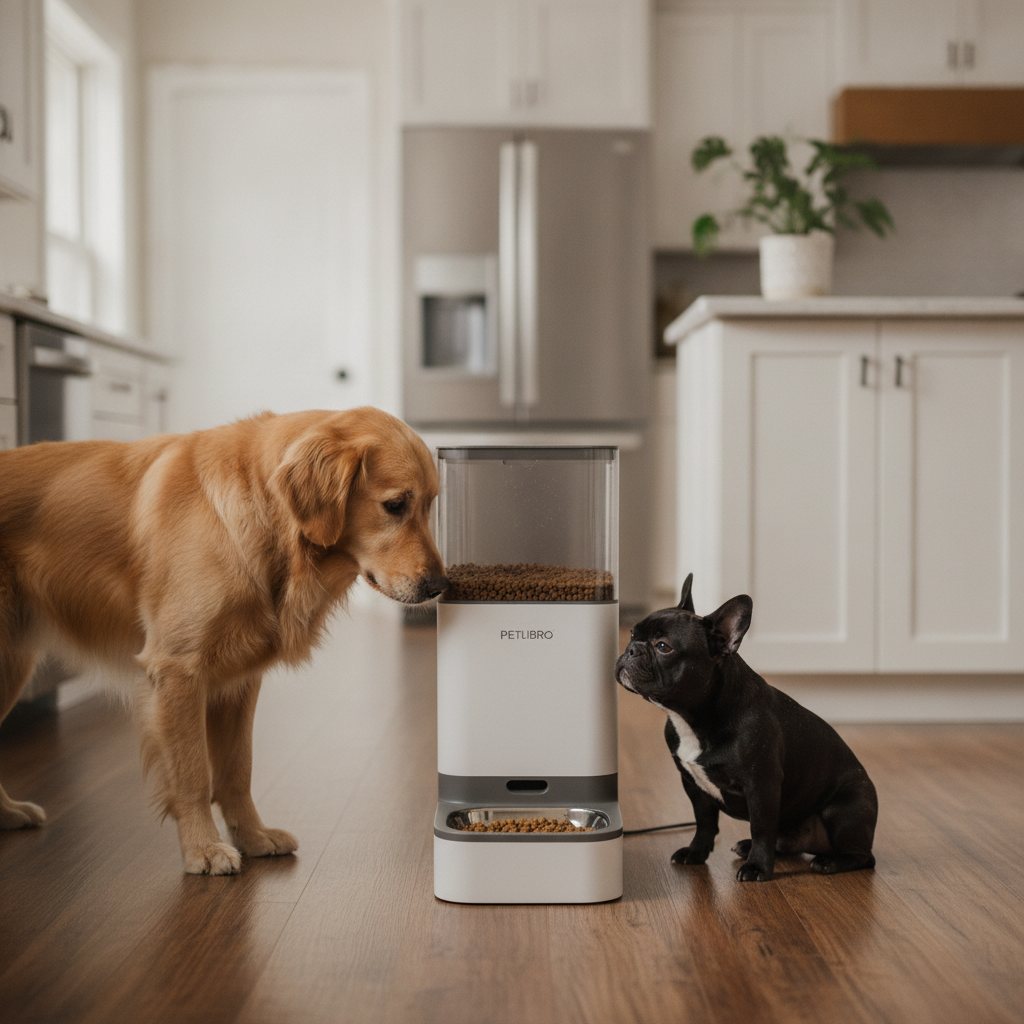
Two dogs, one kitchen. You set a timed feeder, leave for work, and come home to one dog that ate twice and one that missed dinner. The timer fired on schedule — but it dropped food into an open bowl, and a fast eater can finish its own portion and then take the slow one's. In a multi-dog or dog-and-cat house, that food stealing, not the schedule, is the real problem.
What problem are you actually solving?
Before any product, answer one question: do your pets steal, or do they just need feeding on time?
If your pets eat side by side and nobody robs the other, you have a scheduling problem, and almost any reliable timed feeder solves it — buy on capacity and price. But if one pet bolts its food and then muscles into the other's bowl, you have a stealing problem no shared feeder will fix: it drops one portion into one bowl for whoever shows up, and the faster eater wins.
There are only two honest fixes for stealing. Access control: a feeder that opens only for the right pet, using a microchip or RFID collar tag. Physical separation: one programmable feeder per pet, in separate rooms, so there's nothing left to steal. Everything below is one of those two answers.
Stealing problem? The SureFeed Microchip Pet Feeder

If one pet robs the other, the SureFeed Microchip Pet Feeder (~$150-200) is the pick — the only common approach that physically blocks the theft. Its sealed lid stays shut until a registered pet steps up. It reads the pet's implanted microchip, or the included RFID collar tag for an unchipped pet, opens, and closes again when that pet leaves (Sure Petcare product page). It stores up to 32 pet identities.
The honest specs: this is a 400ml bowl, not a hopper, and it holds wet or dry food — useful if one pet is on a prescription or wet diet and the other isn't (Sure Petcare). It runs on 4 C-cell batteries lasting roughly six months. Because the bowl isn't a dispenser, you fill it manually; the gating, not the scheduling, is what you pay for. The base model has no app — the Connect version adds app control but needs a Hub (sold separately).
Two owner notes recur. The common complaint is not that the gate fails but that training takes patience: the motor and lid noise spook some pets at first. Owners describe days of leaving the lid set to stay open, treats inside, before the pet will eat from it. And because the bowl is open once the lid is up, wet food dries at the edges over a few hours — it fits scheduled wet meals, not all-day grazing.
Bottom line: for genuine food stealing between pets that share a room, the SureFeed Microchip Pet Feeder is the fix — it locks the thief out at the bowl. Budget one per pet, and budget a week of training.
No stealing, just portions? The PETLIBRO Granary 5L
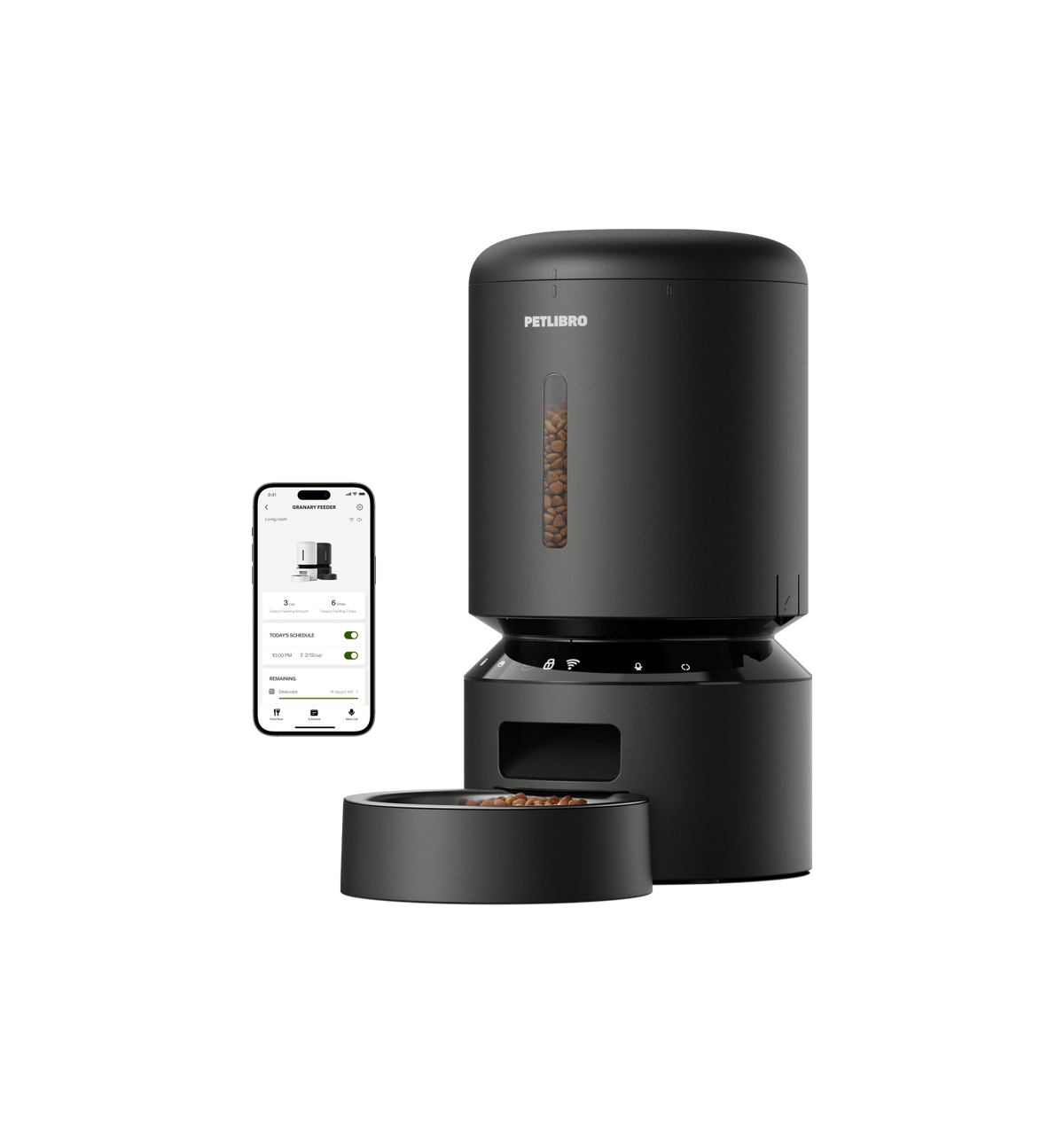
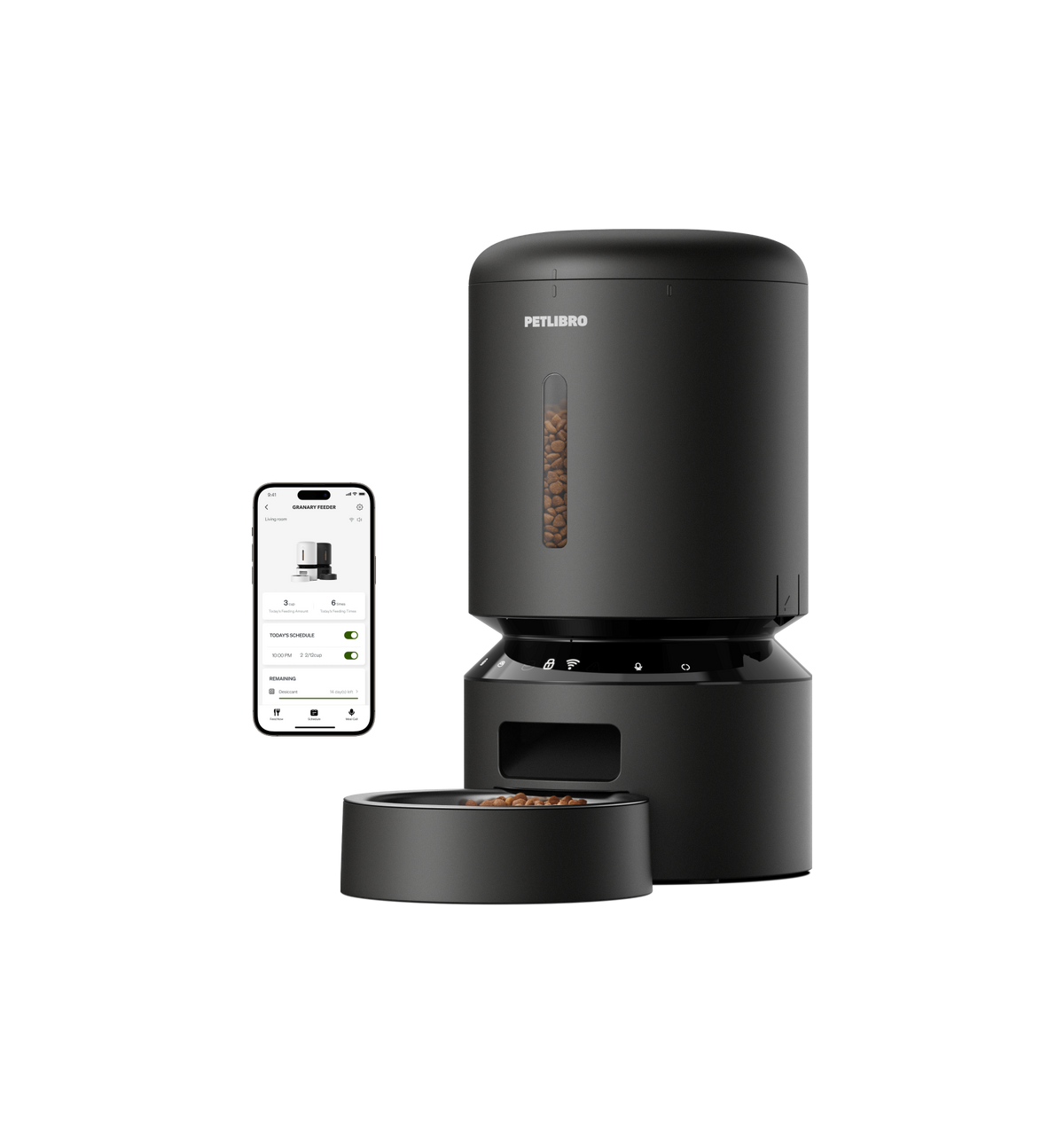
If your pets don't steal but each needs its own schedule and portion, run one programmable feeder per pet — and the PETLIBRO Granary 5L WiFi (~$90) is a solid pick. It's a true dispenser: a sealed 5L hopper (about 24 cups), portions in 1/12-cup steps, up to 10 meals a day, and a twist-lock lid plus desiccant bag to keep kibble dry (PETLIBRO Granary page). It handles kibble 2-15mm in diameter, which matters for the jam question below.
For multi-pet use, the deciding spec is per-pet portions: two of these, one per dog, feed a 70-pound dog and a 15-pound dog different amounts on independent schedules. It runs on DC power with 3 D-cell batteries as backup. The honest catch: on battery, Wi-Fi shuts off to save power. It keeps feeding the schedule during an outage; you just can't change it remotely until power returns.
Two owner complaints set the expectation. First, jam and false-jam alerts: owners report the unit logging a "blockage" or skipping a portion, most often with large or irregular kibble outside the 2-15mm spec. Matching your kibble to that window is the practical fix. Second, Wi-Fi reconnection: a recurring report is the feeder dropping its connection after a router restart and needing a full re-pair in the app. Neither stops it feeding the stored schedule offline.
Bottom line: for a non-stealing multi-pet home, two PETLIBRO Granary feeders — one per pet, in separate spots — give each dog its own schedule and portion at a fair price. Keep kibble in the 2-15mm range to avoid jams.
The cheaper anti-jam option: PETKIT Fresh Element Infinity
For owners who want jam-resistance baked in, the PETKIT Fresh Element Infinity 5L (~$60-80) is the budget standout. It has the same 5L capacity but adds a weight sensor that weighs each drop and re-triggers if the dispensed amount is short (PETKIT Infinity page). PETKIT markets this as its anti-clog system, so treat it as portion-correction against a partial jam — not a guarantee against every jam. Portions run 5-200g per meal, up to 10 meals a day, with USB-adapter battery backup. The one caveat: it's 2.4GHz Wi-Fi only, so a 5GHz-only router needs a 2.4GHz band enabled.
For the tightest budgets, the WOPET 8L (~$45-60) trades smarts for raw capacity — up to roughly 29 cups, 1-4 meals a day, 3 D-cell battery backup — but it's dry-food only and dispenses in coarse 10g-class steps, so you can't fine-tune small portions. It's a reasonable second station for a big dog that eats a lot, not the precision pick.
How the multi-pet feeders compare
| Feeder | Price | Capacity | Portion accuracy | Power + backup | Wi-Fi | Microchip / RFID | Pets per unit | Best for |
|---|---|---|---|---|---|---|---|---|
| SureFeed Microchip | ~$150-200 | 400ml bowl | Portion guide to 1g | 4× C battery (~6 mo) | None (Connect adds app + Hub) | Yes | 1 (32 IDs in memory) | Pets that steal and share a room |
| PETLIBRO Granary 5L | ~$90 | 5L (~24 cups) | 1/12-cup steps, ~0.5g | DC + 3× D backup (Wi-Fi off on battery) | 2.4 / 5GHz | No | 1 per feeder | Per-pet portions, reliable default |
| PETKIT Infinity 5L | ~$60-80 | 5L | 5-200g, weight-sensed | USB + battery backup | 2.4GHz only | No | 1 per feeder | Jam-prone kibble, budget smart |
| WOPET 8L | ~$45-60 | 8L (~29 cups) | 10g steps | DC + 3× D backup | None (basic) | No | 1 per feeder | Big eater, lowest cost |
Pricing approximate, in USD, June 2026; all brands run promotions, so verify current price on each listing. SureFeed US street price varies widely — check before buying.
Who should NOT buy each — and the one most homes should pick
- Skip a single shared feeder for free-feeding multi-dog homes. The faster eater takes both portions — the one setup almost guaranteed to fail your stealing problem.
- Skip microchip feeders if your pets aren't chipped and won't wear a collar tag. The SureFeed needs a microchip or its RFID collar tag to read — no tag, nothing to gate.
- Skip the SureFeed if your problem is only scheduling. You'd pay a premium for gating you don't need and fill a 400ml bowl by hand. A dispensing feeder is cheaper and less work.
- Skip the WOPET if you need precise small portions or wet/prescription food — it's a high-capacity dry dispenser, not a precision or gated unit.
The verdict: our picks by household
The right machine depends on whether your pets steal:
- Pets steal and share a room: SureFeed Microchip Pet Feeder, one per pet — the only setup here that locks the thief out at the bowl.
- No stealing, different portions, want it reliable: two PETLIBRO Granary 5L feeders, one per pet in separate spots.
- No stealing, tight budget or jam-prone kibble: the PETKIT Fresh Element Infinity, per pet.
Bottom line: most multi-pet homes don't need a microchip feeder — they need two programmable feeders in separate rooms, one per pet, so each gets its own schedule and portion. Reserve the SureFeed for genuine food theft between pets that can't be separated. Either way, set each pet's portion with a measuring cup and your vet's guidance.
Two more reads if you're still deciding: the best automatic cat feeder 2026 guide covers wet-food and camera angles, and the PETLIBRO vs Whisker Feeder-Robot hands-on digs into hopper size and jam-resistance for a single high-capacity unit. For the "is this gadget worth it" lens, see smart pet gadgets worth it vs gimmick.
The feeders handle the schedule and, with gating, the stealing — but they can't decide the right amount. The American Animal Hospital Association is blunt: measure portions with a real cup, set them to each pet's weight, and favor smaller, more frequent meals over one big drop. Hardware owns the timing; you still own the diet.