Litter-Robot 4 vs PETKIT PUROBOT: Which Fits Your Home?
Compare Litter-Robot 4 and PETKIT PUROBOT by cat fit, cleaning, app features, privacy, and long-term ownership before choosing.
Pubblicato il 30 ago 2026 · 5 min di lettura
Questa guida non è ancora stata tradotta, quindi stai leggendo la versione originale in inglese.
As an Amazon Associate, I earn from qualifying purchases. Your price stays the same.
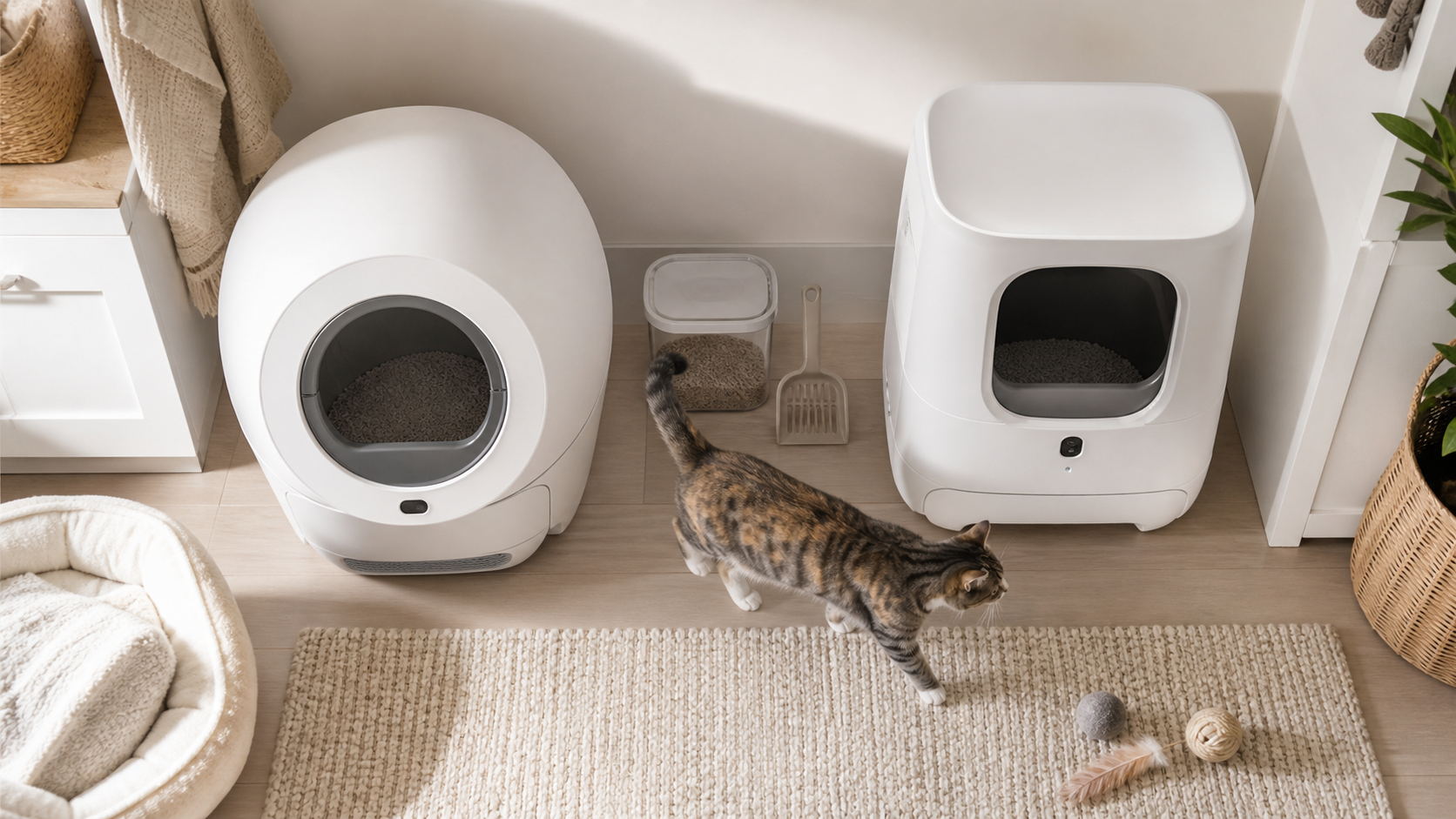
As an Amazon Associate, I earn from qualifying purchases. The price you pay is the same. This guide is based on manufacturer specifications, published independent reviews, and verified-buyer feedback, not hands-on testing.
Litter-Robot 4 and PETKIT PUROBOT target the same basic problem: reducing daily litter scooping. The better choice depends less on headline features and more on whether the box suits your cat, your preferred litter, your cleaning tolerance, and your comfort with connected devices. I would not choose either until those practical points are clear.
If you want to observe whether a cat actually enters and exits a new automatic box, a separate camera can be useful during the transition. The WYZE Cam v4 is one available option, although a general-purpose camera is not a replacement for checking the litter box and your cat directly.
The short answer
Choose between Litter-Robot 4 and PETKIT PUROBOT by working through five questions: Will your cat comfortably use the opening and interior? Does the machine support your normal litter? How much disassembly does routine cleaning require? Which app functions do you genuinely need? What happens when proprietary bags, filters, or other consumables are unavailable?
Neither machine is automatically the safer purchase for every household. A cautious cat may prefer the unit with the less intimidating entrance and quieter operating pattern, while a multi-cat household may care more about waste capacity, identification reliability, and how clearly the app separates activity records. Those points should be checked against current manufacturer documentation and recent independent reviews because product software and bundles can change.
Cat acceptance matters more than the app
An automatic litter box has no value if the cat avoids it. Before comparing dashboards and notifications, look at the physical route into the box. Consider entrance height, the size of the opening, the amount of enclosed space, and whether your cat can turn around without appearing cramped.
This is particularly important for large cats, older cats, and cats with limited mobility. Do not assume that a stated weight range tells the whole story. Body length, posture, and willingness to enter an enclosed chamber can matter just as much.
Keep the existing litter box available during the transition rather than forcing an immediate switch. Follow the manufacturer’s acclimation guidance, and initially avoid running an automatic cycle while a nervous cat is nearby. If litter-box habits change or you have concerns about mobility, elimination, or stress, consult your vet.
Compare the cleaning process, not just automatic scooping
“Self-cleaning” means the machine separates waste from usable litter. It does not mean the entire unit cleans itself. Both options still need waste removal, litter replenishment, interior wiping, and periodic deeper cleaning.
When comparing Litter-Robot 4 with PETKIT PUROBOT, inspect the cleaning instructions and answer these questions:
- Which parts detach without tools?
- Can litter collect inside seams, tracks, or sensor areas?
- Are the removable components washable?
- How difficult is it to reach the waste drawer and interior surfaces?
- Must electrical sections be protected during cleaning?
- How long will the box be unavailable after a deep clean?
Published owner feedback is especially useful here. Product pages explain the intended process, but long-term reviews can reveal whether litter tends to migrate into awkward areas or whether reassembly regularly causes confusion. Give more weight to repeated, specific complaints than to a single unusually positive or negative review.
Check litter compatibility before buying
Automatic boxes rely on litter moving through a sifting mechanism. That makes litter type more important than it is with a basic tray. Check each manufacturer’s current compatibility guidance rather than assuming that your preferred litter will work.
If changing litter would be necessary, include that disruption in the decision. A cat would then be adjusting to both a new box and a new substrate. It may be easier to introduce one change at a time.
Also consider tracking outside the box. A larger machine does not necessarily contain every granule, particularly if the entrance design encourages a cat to jump out quickly. A suitable mat and regular floor cleaning may still be needed with either model.
App features can help, but they create dependencies
Connected litter boxes may provide activity records, status information, and maintenance alerts. These can be convenient, particularly in multi-person households where nobody is sure whether the drawer was emptied. However, an app also introduces account security, network compatibility, notification settings, cloud services, and future software support into what was once a simple household object.
I would compare the current app documentation for both products and ask:
- Can essential cleaning cycles run without an internet connection?
- Can more than one household member access the device?
- What information is stored in the account?
- Can unwanted notifications be disabled?
- Does the box retain basic functions if the service is temporarily unavailable?
- Is account deletion explained clearly?
Do not buy based on a health-related app claim alone. Activity data may help you notice a change worth investigating, but it is not a diagnosis. Discuss persistent changes in litter-box behavior with a veterinarian.
Multi-cat homes need a stricter comparison
For a one-cat household, an activity log may only need to show that the box was visited. With multiple cats, the question becomes whether the system can distinguish individual animals consistently enough to make the records useful.
Check the published identification method and its limitations. Then read independent reports from households with cats of similar size. Even if identification works well, the household may still need more than one litter location. One automatic box can become a bottleneck if several cats want access or if one cat guards the entrance.
A camera can help owners observe approach and avoidance patterns, but it should be positioned with privacy and account security in mind. Avoid placing it where it captures more of the home than necessary, and use a unique password with any available account protections.
Budget for ownership beyond the machine
The purchase price is only one part of the decision. Review the required and optional consumables for each model, including liners, filters, odor-control accessories, cleaning products, and replacement components. Confirm whether ordinary alternatives are permitted or whether using them affects operation or warranty coverage.
Warranty terms also deserve attention because automatic litter boxes combine moving parts, sensors, software, and components exposed to litter dust. Read what is covered, who pays shipping, and whether replacement parts can be ordered separately. Availability in your country may matter as much as the nominal warranty length.
Who should skip both?
Skip both for now if your cat strongly avoids enclosed boxes, cannot comfortably manage the entrance, or is already experiencing unexplained litter-box changes. A conventional open tray may also be more practical if you dislike account-based devices, have unreliable connectivity, or want every component to be easy to replace locally.
Renters and people with limited cleaning space should check the full exterior dimensions and deep-cleaning procedure before committing. An automatic box occupies more than its listed footprint once you allow room to access drawers, remove panels, and work around it.
Final decision
Litter-Robot 4 versus PETKIT PUROBOT is ultimately a fit-and-maintenance decision, not a contest over which app has the longest feature list. Prioritize cat access, litter compatibility, manual operation during outages, cleaning effort, consumable availability, and support in your region.
Before ordering either model, download its current manual and map the complete cleaning process in the space where you plan to install it. If one option creates fewer compromises for both your cat and your weekly routine, that is the more sensible choice.
Idee regalo e verifica delle offerte
Scopri tutte le guide e le verifiche delle offerteHow we research: This guide is based on manufacturer specifications, published independent reviews, and verified-buyer feedback, not hands-on testing.
Nuove recensioni sulla tecnologia per animali ogni settimana
Un'email a settimana con l'ultima recensione e gli accessori che i proprietari di animali acquistano davvero. Niente spam, puoi annullare l'iscrizione in qualsiasi momento.