Automatic Dog Paw Cleaners: Useful Gadget or Extra Chore?
Automatic paw cleaners can reduce scrubbing, but noise, cleanup, and dog tolerance determine whether they are genuinely convenient.
Publié le 4 sept. 2026 · 5 min de lecture
Ce guide n’est pas encore traduit. Vous consultez donc la version originale en anglais.
As an Amazon Associate, I earn from qualifying purchases. Your price stays the same.
As an Amazon Associate, I earn from qualifying purchases. The price you pay is the same. This guide is based on manufacturer specifications, published independent reviews, and verified-buyer feedback, not hands-on testing.
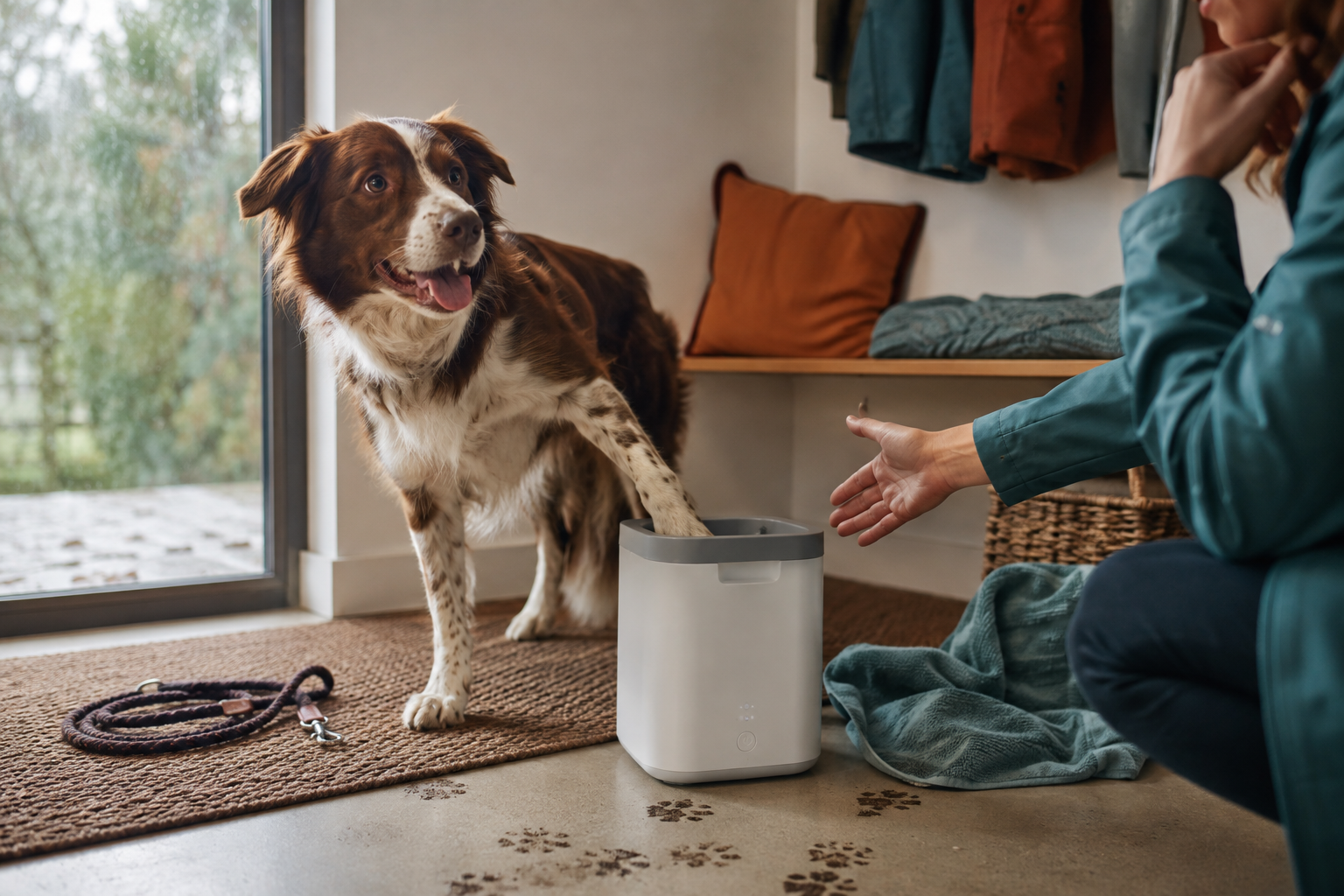
An automatic dog paw cleaner can be useful if muddy walks are routine and your dog calmly accepts having each paw placed inside a powered device. It is less convincing for noise-sensitive dogs, quick wipe-downs, or homes where cleaning the machine takes longer than cleaning the paws. The key question is not whether the cleaner spins automatically, but whether it reduces the total effort without frightening your dog.
A related tool for spotting muddy-door habits
If the larger problem is figuring out when a dog comes inside dirty or which entrance causes the mess, a movable indoor camera may be more useful than another cleaning appliance. The WYZE Cam Pan v3 is an option to consider for monitoring an entry area. A camera does not clean paws, but it can help a household respond before muddy tracks spread through multiple rooms.
What does “automatic” actually mean?
Most products in this category resemble a cup or compact chamber into which one paw is inserted at a time. A powered mechanism moves internal cleaning elements around the paw. That distinguishes them from manual paw-cleaning cups, which depend on the owner rotating or moving the cup.
Automatic does not mean hands-free. Someone still has to prepare the device, guide each paw into it, keep the dog steady, inspect the result, dry the paw, and clean the machine afterward. Long-haired paws may also require more checking because moisture and debris can remain between pads or in the surrounding fur.
I would therefore evaluate these products as assisted cleaning tools rather than tiny dog washing machines. The motor may eliminate repetitive twisting, but it does not remove the handling and maintenance steps.
When an automatic paw cleaner makes sense
Your dog regularly comes home with wet dirt
A powered cleaner is easiest to justify when paw washing is a frequent task rather than an occasional response to unusually bad weather. Soft, wet dirt is also a more natural match for a washing device than dried clumps, burrs, sticky substances, or debris caught deeply in fur.
Your dog accepts close paw handling
The device must fit into a routine your dog can tolerate. A dog that already allows calm paw handling is a better candidate than one that pulls away when its feet are touched. Motor sound and movement introduce additional variables, even if the dog is comfortable with towels or a conventional bowl.
You have a practical cleaning station
The setup works better near an entrance with towels, water, and a place to empty or rinse the unit. If the cleaner lives in a distant cupboard or requires several trips to prepare, its automatic mechanism may not save meaningful time.
Reasons to skip one
Your dog is sensitive to noise or confinement
A paw placed inside a narrow moving device can feel restrictive. Forcing the process may make later handling harder, so a nervous dog should be introduced gradually with the machine off. If the dog repeatedly shows distress, a towel, shallow basin, or manual cleaning cup is the more sensible choice.
You mainly deal with light dust
Dry dust often needs only a quick wipe. Adding water can turn it into a film that then requires rinsing and drying. An automatic cleaner is more equipment than the task demands in that situation.
You expect it to inspect the paw for you
A motorized cup cannot determine whether a paw has a cut, damaged nail, lodged object, sore pad, or skin irritation. Owners still need to look and feel carefully rather than assuming a visibly cleaner paw is fine. For persistent redness, pain, swelling, limping, or other health concerns, consult your vet instead of relying on a cleaning gadget.
The device is awkward to wash
Product demonstrations often emphasize the spinning action and spend less time on what happens afterward. Mud, hair, and dirty water remain inside the cleaner. If the internal section is difficult to remove, rinse, and dry, the product can simply move the unpleasant work from the dog’s paw to the appliance.
What to check before buying
Opening and chamber shape: Check the manufacturer’s sizing guidance against the widest part of the dog’s paw. Do not assume a general small, medium, or large label will fit every breed.
Cleaning surfaces: Internal elements should appear flexible and free of sharp edges. Read verified-buyer feedback for reports involving pinched fur or uncomfortable contact.
Disassembly: Look for clear instructions showing which dirty components can be removed and washed.
Controls: A straightforward control is preferable when the other hand is supporting a dog. Complicated mode selection adds little to this job.
Power arrangement: Consider where the cleaner will be stored and used. A convenient power design on paper may still be inconvenient beside a wet doorway.
Noise comments: Published specifications rarely communicate how a particular dog will react. Owner reviews can reveal whether noise or vibration is a recurring complaint, although individual tolerance will vary.
Return policy: Fit and dog acceptance are difficult to predict remotely. Review the seller’s current terms before ordering.
How to introduce the cleaner without creating a struggle
Let the dog investigate the inactive cleaner without placing a paw inside.
Practice brief, gentle paw handling separately from the machine.
Place one paw into the inactive chamber for a moment, then remove it calmly.
Run the motor away from the dog so the sound is not introduced at the same moment as confinement.
Combine the steps only after the dog remains relaxed around each one.
Stop if the dog struggles, freezes, or becomes increasingly worried. Convenience is not worth turning routine paw care into a repeated conflict.
Keep early sessions brief and follow the manufacturer’s operating instructions. Water, cleaning solutions, and powered parts require careful handling. If a product suggests adding anything beyond water, confirm that it is suitable for dogs and consult your vet when there is any concern about irritated or damaged skin.
Automatic cleaner versus simpler alternatives
A towel remains the quickest option for light moisture and surface dirt. A shallow basin offers direct visibility and may be easier for dogs that dislike enclosed devices. Manual paw-cleaning cups provide a similar enclosed washing action without motor noise, although they require more hand movement.
An automatic model earns its place when powered movement meaningfully reduces repetitive work and the dog accepts the process. It is not automatically cleaner, gentler, or faster merely because it has a motor. Maintenance, drying, setup, and cooperation determine the actual result.
The practical verdict
An automatic dog paw cleaner is worth considering for frequent muddy walks, a cooperative dog, and an entryway where the unit can stay ready and be rinsed easily. Skip it when paw cleaning is occasional, your dog dislikes foot handling, or a towel already solves the problem in seconds.
Before buying, compare fit guidance, cleaning instructions, noise-related owner feedback, and return terms. Then rehearse the routine with a cup or basin: if four-paw washing already feels awkward, adding a motor probably will not fix the underlying problem.
Idées cadeaux et vérifications des offres
- Promos Black Friday 2026 sur les appareils connectés pour animaux : reconnaître les vraies réductions (et compter l’abonnement)
- Prime Big Deal Days 2026 PetTech Deals for Dog and Cat Owners
- Top 10 Pet Tech Products on Amazon Right Now (September 2026)
- What PETKIT’s New Distribution Deal Means for Smart Pet Buyers
How we research: This guide is based on manufacturer specifications, published independent reviews, and verified-buyer feedback, not hands-on testing.
De nouveaux tests d’accessoires connectés pour animaux chaque semaine
Un e-mail par semaine avec notre dernier test et les équipements que les propriétaires d’animaux achètent vraiment. Aucun spam, désinscription à tout moment.