Cat Mate Elite Microchip Cat Flap (355) vs PetSafe 4-Way Locking Microchip Entry Cat Door: Which Is Better for Your Cats?
Compare Cat Mate Elite and PetSafe microchip cat doors for timed access, multi-cat capacity, entry control, and practical safety limits.
نُشر بتاريخ 08/11/2026 · 9 دقائق قراءة
لم يُترجم هذا الدليل بعد، لذا تقرأ الآن النسخة الإنجليزية الأصلية.
As an Amazon Associate, I earn from qualifying purchases. Your price stays the same.
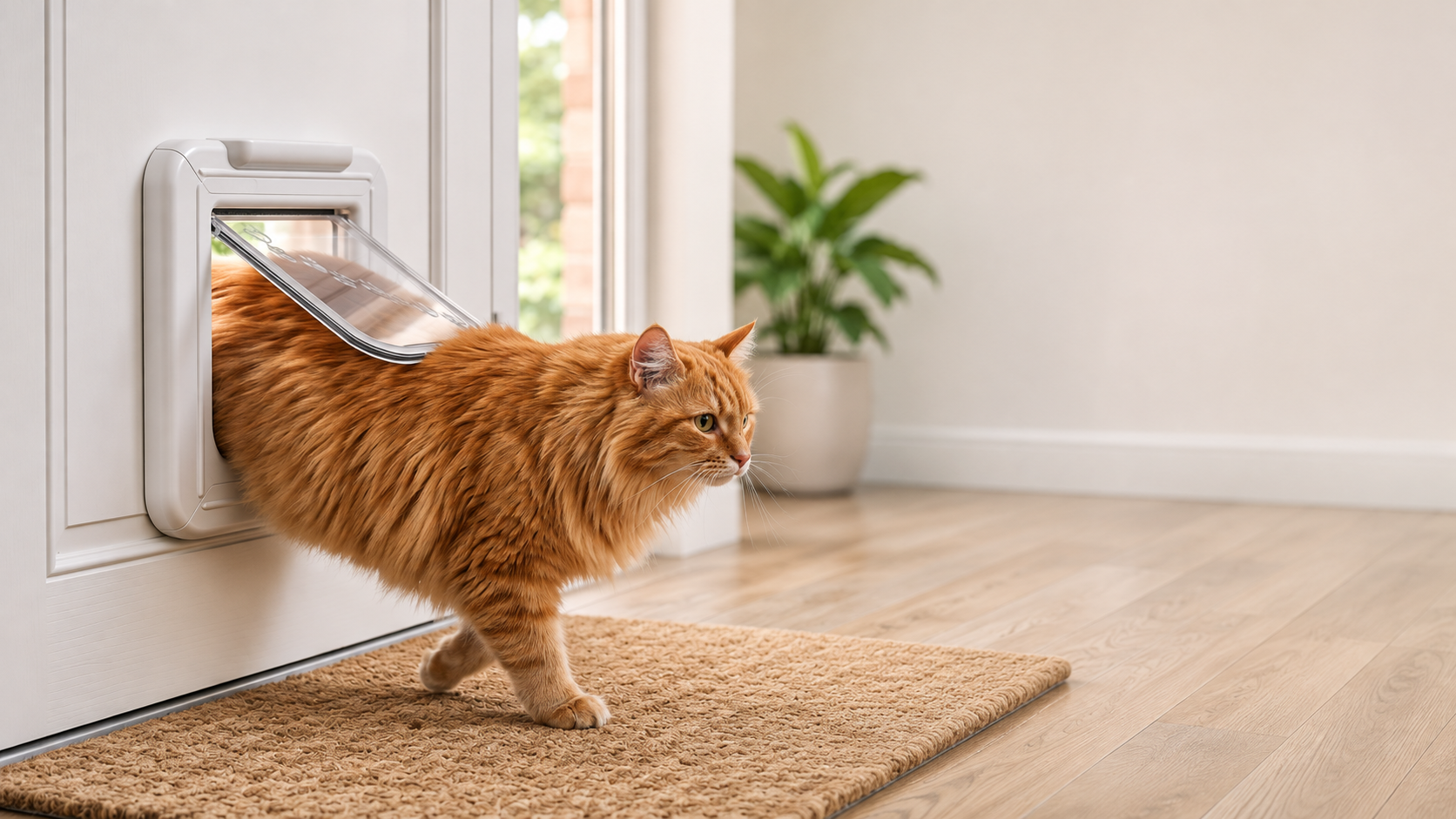
Cat Mate Elite Microchip Cat Flap (355) vs PetSafe 4-Way Locking Microchip Entry Cat Door: Which Is Better for Your Cats?
Choosing between these microchip cat doors starts with your household's access rules. The Cat Mate Elite Microchip Cat Flap (355) offers timer-controlled access, while the PetSafe 4-Way Locking Microchip Entry Cat Door supports up to 40 programmed pets. This comparison explains which advantage matters, what to check before installation, and why selective entry should not be mistaken for complete outdoor safety.
Quick pick: Cat Mate Elite Microchip Cat Flap (355). It best suits owners who want timer-controlled access and do not need a large registration capacity. See it on Amazon (affiliate link).
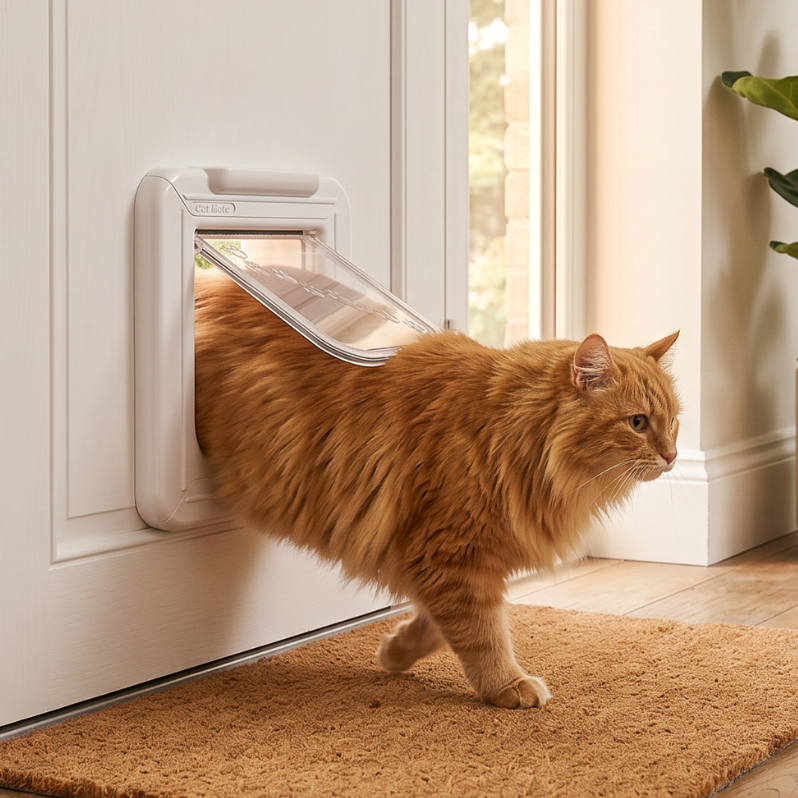
Cat Mate Elite vs PetSafe Microchip Cat Door: The Main Differences
The strongest reason to choose Cat Mate is its scheduling feature. The manufacturer identifies the Elite as a microchip flap with timer control. That makes it the more relevant starting point if your buying decision revolves around a regular access schedule.
PetSafe's clearest advantage is registration capacity. Its product listing specifies up to 40 programmed pets and recognition of a cat's unique 15-digit microchip. That capacity deserves attention in a large multi-cat household, although registration capacity alone does not establish how well a door fits your daily routine.
| Decision point | Cat Mate Elite Microchip Cat Flap (355) | PetSafe 4-Way Locking Microchip Entry Cat Door |
|---|---|---|
| Main reason to shortlist | Timer-controlled access | Registration for up to 40 pets |
| Identification method | Microchip or Cat Mate identification disc, sold separately | Cat's unique 15-digit microchip |
| Listed registration capacity | Nine cats | 40 pets |
| Notable control feature | Timer control and an LCD | Four-way locking |
| Strongest household match | Owners prioritizing a timed routine | Owners prioritizing substantial registration capacity |
The final row is an editorial recommendation, not a performance ranking. A household with two cats should not choose PetSafe simply because 40 is a larger number. Equally, an owner who has no use for scheduling should not treat Cat Mate's timer as an automatic reason to buy it.
Cat Mate Elite Microchip Cat Flap (355): Best for a Timed Access Routine
What makes it worth considering
The Cat Mate Elite accepts a cat's implanted microchip or a Cat Mate identification disc, available separately. The manufacturer describes this as selective entry intended to help keep unwanted animals out while allowing recognized pets access.
Its distinguishing feature here is timer control. If you want access rules to follow a regular household schedule, that feature is more directly relevant than spare registration slots you may never use.
For example, suppose your priority is establishing an evening routine. A timer-equipped door belongs on your shortlist, but you still need to understand exactly how its settings affect entry and exit. Write down the outcome you want before setup: should a cat outside still be able to return after the scheduled change, and should a cat indoors be prevented from leaving?
Those are operational questions, not interchangeable meanings of the word “curfew.” Follow the model's instructions rather than assuming a timed setting behaves as you expect.
The independent review also lists an LCD and capacity for nine cats. Nine registrations may be sufficient for your household, making PetSafe's larger capacity irrelevant to the purchase.
The main trade-off
Cat Mate is the weaker fit if you need more than its reported nine-cat capacity. In that situation, PetSafe's larger registration allowance is a concrete advantage rather than a marketing detail.
There is also a security limit worth taking seriously. The independent Cat Mate review specifically flags free exit and warns against treating the door as raccoon-proof. Buy it for the access functions it offers, not as a substitute for a secure wildlife barrier.
The optional identification disc gives owners another recognition method, but it is a separate purchase. Include that accessory in your comparison if you plan to use it instead of an implanted microchip.
Who should buy it, and who should skip it
Choose Cat Mate if timed access is a genuine requirement, its registration capacity covers your cats, and you are prepared to check how the controls work before relying on them.
Skip it if your household needs more registrations, if you expect the timer to physically bring an absent cat home, or if your requirement is guaranteed protection against wildlife entry. A schedule changes a door's operation; it does not establish where your cat is.
See it on Amazon (affiliate link).
PetSafe 4-Way Locking Microchip Entry Cat Door: Best for Larger Registration Needs
What makes it worth considering
PetSafe's manufacturer page identifies a cat's 15-digit microchip as the access credential. Its product listing states that owners can program up to 40 pets.
For a household needing more than nine registrations, that is the clearest reason to prefer it over Cat Mate. You are buying room for more recognized animals, not merely choosing a door with a bigger specification on the box.
The product is also listed as having a four-way lock. Treat that as a control feature to understand during setup, rather than assuming the phrase answers every question about how individual cats may enter or leave.
Consider a household with several resident cats and plans to add more. Registration headroom may matter more than a timed routine. Conversely, a two-cat household gains little from unused registration slots if its main concern is controlling access on a schedule.
The main trade-off
Large registration capacity is not evidence of individualized household rules. Do not infer that a door can give one cat outdoor access while keeping another inside simply because it can recognize many microchips.
Before buying for a mixed-access household, define the exact rule you need. “Let our cats return home” and “allow only one of our cats outside” are different requirements. A product that meets the first should not automatically be purchased for the second.
Microchip compatibility also deserves a specific check. PetSafe identifies a 15-digit microchip requirement, so confirm your cat's identification details against the model's instructions before committing to installation.
Who should buy it, and who should skip it
Choose PetSafe when registration capacity is your deciding requirement and its microchip specification matches your cats. It is the stronger candidate here for owners who would exceed Cat Mate's reported limit.
Skip it if you are choosing solely on the assumption that a higher registration count means stronger security, better weather protection, or more sophisticated scheduling. The count describes how many pets can be programmed, not those other qualities.
If scheduled access is your principal requirement, start with Cat Mate's documented timer feature instead of buying PetSafe for capacity you do not need.
See it on Amazon (affiliate link).
Safety Limits: Separate Entry Control From Outdoor Access
Selective entry is one part of the decision
Both manufacturers describe microchip recognition as a way to restrict entry to recognized pets: Cat Mate uses microchips or its identification discs, while PetSafe uses the cat's 15-digit microchip.
That is the relevant purchase benefit if your concern is an unfamiliar cat using an ordinary flap. It should not be expanded into a promise that outdoor access itself is safe or that every unwanted animal will be excluded under every circumstance.
Keep the decisions separate. First decide whether you want your cat to have independent outdoor access. Then decide how an opening should control movement. Buying a recognition system does not settle the first question for you.
For related planning, see [INTERNAL LINK: planning safe outdoor access for cats].
Treat wildlife exclusion as a separate requirement
Cat Mate's independent review explicitly cautions that free exit does not make the flap a raccoon-proof barrier. If wildlife intrusion is the reason you are shopping, do not assume microchip recognition alone solves it.
The same purchasing discipline applies when evaluating PetSafe: require an explicit answer to your wildlife concern rather than translating selective-entry language into a broader guarantee.
If your acceptable outcome is “no animal can enter through this opening,” reconsider whether an independently usable pet flap fits that requirement at all. A door you keep closed may be the more appropriate option.
What to Check Before Cutting a Door or Booking Installation
Start with your cats and your access rules
Make a short written checklist before comparing accessories or arranging installation:
- How many cats need to be registered?
- Is your priority a timed routine or registration capacity?
- Must all cats follow the same access rules?
- What should happen when a cat is outside at the time access settings change?
- Are you solving unwanted-cat entry, wildlife intrusion, or both?
These questions prevent a common mismatch: buying a technically suitable recognition door that cannot deliver the household routine you had in mind.
For example, an owner with one outdoor cat and one indoor-only cat should put directional access requirements ahead of registration capacity. An owner whose cats all share the same routine may find the choice much simpler.
Verify the physical installation separately
Do not use registration count or control features as a shortcut for checking fit. Before any cutting, compare the exact model's installation instructions with your intended location, existing opening, and any required mounting components.
If you are replacing another flap, measure rather than assuming the old opening will work. If someone else is installing it, ask them to assess the actual location and instructions before you authorize the job.
Also decide how you will use the opening while setting up the door. A purchase plan should include installation and familiarization, not just ordering the product and expecting immediate independent use.
Plan a supervised introduction
Treat the first sessions as setup checks. Follow the manufacturer's registration and operating instructions, observe your cats using the opening, and confirm that the selected settings produce the access pattern you intended.
Do not make the first unsupervised session the moment you discover that your interpretation of a lock setting was wrong. Keep an ordinary way to let your cat in while you establish the routine.
Realistic Alternatives to Either Microchip Door
Keep owner-controlled access
If your schedule allows you to let your cat in and out, keeping the existing door may be the simplest alternative. It avoids buying an access system before you have resolved whether independent entry is actually necessary.
This option particularly deserves consideration when your rules change frequently or when different cats need different treatment. The inconvenience of opening a door may be preferable to purchasing a flap for a requirement it does not meet.
Compare a basic flap only when selective entry is unnecessary
A basic flap belongs in the decision only if recognizing individual pets is not important to you. It addresses movement through an opening, whereas the central reason to consider these two products is their microchip-based entry control.
Do not abandon selective entry merely to simplify the purchase if unfamiliar animals entering your home is the problem you need to solve. Instead, decide whether that problem justifies the additional setup and installation commitment.
Reconsider independent outdoor access
If neither product satisfies your access rules, keeping the exterior door closed is a valid outcome. You do not have to choose the closer match when a critical requirement remains unmet.
This is especially relevant if you need guaranteed containment, different permissions for different cats, or a wildlife barrier. Define the requirement first, then select an arrangement designed to meet it.
Final Recommendation: Buy for the Rule You Need to Enforce
The Cat Mate Elite Microchip Cat Flap (355) is the better starting point for owners prioritizing a timed access routine. The PetSafe 4-Way Locking Microchip Entry Cat Door is the stronger candidate when registration capacity beyond nine cats matters.
Before ordering, write one sentence describing exactly who must be able to pass through the door, in which direction, and when. Use that sentence to check the product's instructions. If the door cannot meet that rule, skip it, regardless of how appealing its other features look.
Sources
أفكار هدايا ومراجعات العروض
اطّلع على جميع الأدلة ومراجعات العروضHow we research: This guide is based on manufacturer specifications, published independent reviews, and verified-buyer feedback, not hands-on testing.
مراجعات جديدة لتقنيات الحيوانات الأليفة كل أسبوع
رسالة أسبوعية واحدة تتضمن أحدث مراجعة والمنتجات التي يشتريها أصحاب الحيوانات الأليفة فعليًا. بلا رسائل مزعجة، ويمكنك إلغاء الاشتراك في أي وقت.